

In September 2020 the architecture centre CAMP filled its gallery with the projects that were supposed to remake Prague. Six years later it has published a status check on all of them, and the list has quietly sorted itself into two categories: things now under construction, and things still being studied.
Under the ground, mostly on schedule
Metro line D is the clearest example of the first group. Tunnelling is under way on the Pankrác–Ryšánka section, with the Pankrác–Olbrachtova stretch starting this month and Olbrachtova–Nové Dvory following two years later. The line runs 10.6 kilometres with nine regular stations and one interchange, and will operate fully automatically without drivers. Hochtief and Subterra were selected in April for the Ryšánka–Tempo section. The opening of Pankrác–Depo Písnice is planned for December 2027, with the full line including Náměstí Míru–Pankrác at the end of 2029.
The airport rail link is the other large civil-engineering commitment, targeted for completion in 2030 and part-funded through the EU's Connecting Europe Facility. It is being built in overlapping segments: Masarykovo nádraží expands from seven tracks to nine by 2027, Bubny–Výstaviště completes this year, Veleslavín–Ruzyně in 2028, and the Výstaviště–Dejvice, Dejvice–Veleslavín and Ruzyně–airport sections in 2029. The finished route adds six stations, runs fully electrified and double-tracked, and includes a transfer terminal at Dlouhá Míle with over a thousand park-and-ride spaces.
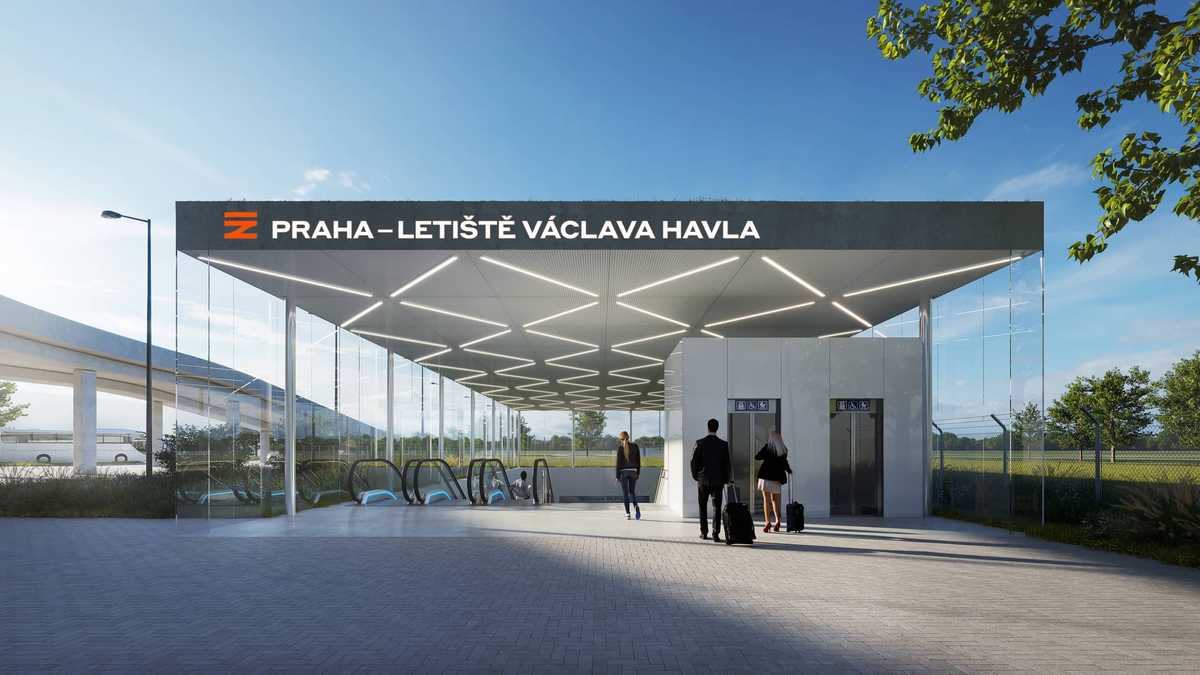
Visualisation of the airport station by Správa železnic, from the project's entry on CAMP's Praha zítra?. A design, not a photograph — the line is due in 2030.
The city ring road remains the long tail. Documentation work on the 10.5-kilometre completion — Pelc-Tyrolka–Balabenka, the Štěrboholská radiála and the Libeňská spojka, largely in tunnel — began in November 2025, with a permit application expected in early 2027 and opening projected for the second half of the 2030s.
Two river crossings, already done
Dvorecký most opened ceremonially in April: 331.6 metres, six spans, prestressed concrete, carrying trams, pedestrians and cyclists but no cars, and set a metre above the 2002 flood level. It was designed by Tubes Atelier and Atelier 6 at a cost of around a billion crowns, with a sculptural garden by Kryštof Kintera. The Troja footbridge, replacing the structure that collapsed in 2017, is also complete.
The squares are where residents will notice
Wenceslas Square is half finished: the lower section is done and the upper section is a building site, with the new tram line from Jindřišská to Vinohradská expected to carry its first passengers in June 2027.
Karlovo náměstí — at over 70,000 square metres the largest square in the country — is the bigger undertaking. Dendrological work and tree relocation ran from autumn 2025 through spring 2026 at roughly nine million crowns; the main revitalisation begins this year and must finish by November 2030 to satisfy its EU funding. The roughly 250-million-crown design by Rehwaldt Landschaftsarchitekten with BY Architects and PD Filip rebuilds the path network and adds a café, a children's playground, an outdoor exhibition space and a market area by the New Town Hall. The stated aim is prosaic and telling: a comfortable route across the square, particularly from the metro toward the hospital.
Also moving: the Hradební korzo, a continuous circuit tracing the former fortification line from Národní třída through Revoluční, with Aoc architekti holding creative authority alongside Metroprojekt. Reconstruction of Revoluční is planned to start in 2027.
Still on paper
The brownfields tell the other half of the story. Smíchov is the exception that proves it — genuinely under construction, with around 1,600 apartments across two sections, a Česká spořitelna headquarters in the southern half, a kilometre-long pedestrian spine linking them, terminal completion at the end of 2028 and the public transport terminal by 2030.
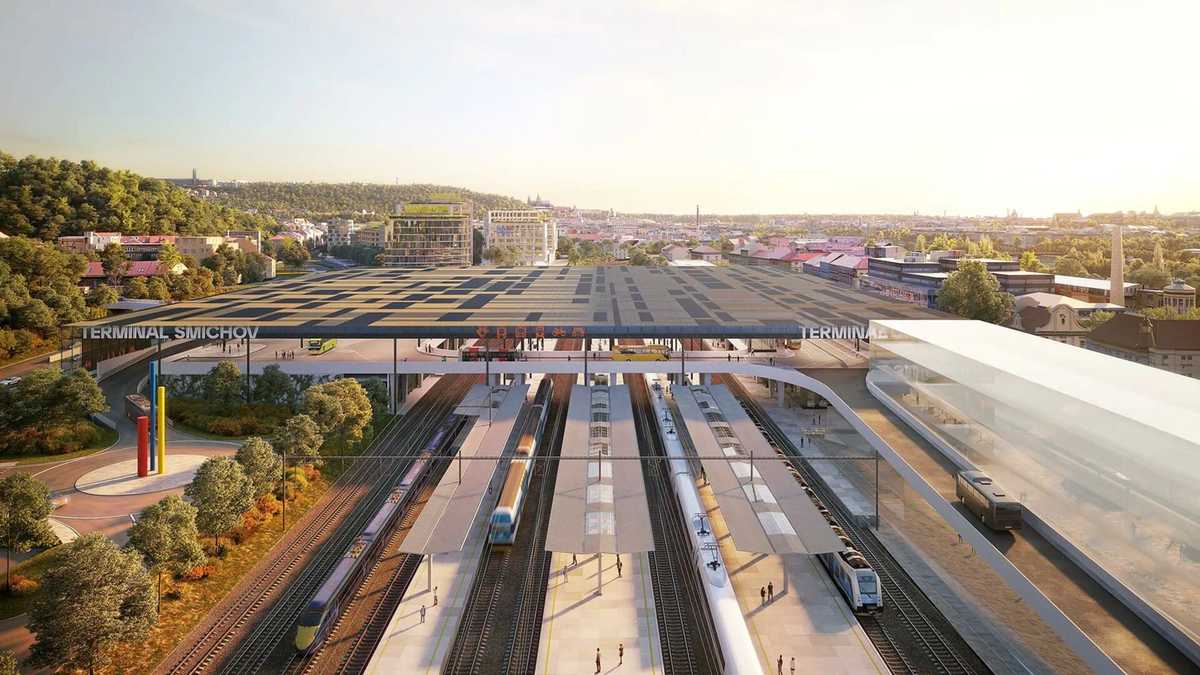
Visualisation of the transport terminal by A69 - architekti, from the project's entry on CAMP's Praha zítra?. It is a design, not a photograph — the terminal is due in 2030.
Elsewhere it is studies. Rohan City has a Daniel Libeskind visualisation. Bubny-Zátory is still completing its territorial study. Bohdalec-Slatiny finished a pre-verification study by Jakub Cigler Architekti in February 2025 and has a territorial study tender in preparation. Nákladové nádraží Žižkov is the middle case: buildings visualised, and a tram line with five new stops running through the district to Jarov.
Holešovická tržnice is on a transformation running to 2038 with total investment around five billion crowns; the Burza building restoration finished in 2025. The Vltava Philharmonic expects to file for a building permit this summer.
Six years produced two opened bridges, one metro line under construction, an airport railway in pieces across the city, and a set of brownfields that are better documented than they were. Whether that reads as progress depends entirely on which half of the list you were waiting for.
Sources
- 01Pražské priority: Velký update projektů, které promění tvář metropolepraha.camp (CAMP) · 4 June 2026